January 16, 2012

Photo focus: Invasive species in a new light

We'll start the new year with a couple of Kelly's photos from a walk we took on a 54-degree (F) day in January (!) along the Platte River by Kearney, NE.  Kelly enjoys finding texture and interesting light conditions.

Unfortunately, her subject this time is an aggressive, invasive species that causes pains of agony for managers along the Platte.  It sucks up tremendous amounts of water, and make impenetrable areas of vegetation.  Biologists have been resorting to using helicopters or aquatic 'tanks' to treat large areas with herbicide to stall the spread of Phragmites.

However, it turns out it can be quite photogenic.

Phragmites along the Platte River in Nebraska, January 2012 (photo by Kelly Powell).

Sunlight dances on the surface of the Platte River (photo by Kelly Powell).

Occupy the Platte: we are the 1%

A flock of approximately 1,200 sandhill cranes occupies a soybean field in south-central Nebraska.  Fed up with
governmental policies that demand they fly extraordinarily long distances to migrate, these cranes (actually,
a bit fewer than 1% of the population which migrates through Nebraska each spring) are 'taking it to the man'
by waiting for spring (photo by Kelly Powell).
There is an intriguing event happening this winter on the Platte River in central Nebraska. Approximately 3000 sandhill cranes are still in Nebraska, having stopped during the fall migration.  Their colleagues (the rest of the 450,000 or so sandhills that migrate through Nebraska) went on to more southerly, traditional latitudes.

I spoke to an employee of Rowe Sanctuary, this morning, who wonders if these cranes first migrated south, found the effects of the 2011 drought to be unsatisfactory, and traveled back north.

Normally, Nebraska sees cranes in the spring when they stop to refuel on their way northward. Corn eaten from the Platte River Valley provides insurance when they arrive on the breeding grounds in Canada--in case they arrive to frozen conditions. But, Nebraska rarely sees the cranes for very long on fall migration.

The question worth asking is: are we seeing the first of a new pattern caused by high food resources (corn) in the Platte River Valley, teamed with a mild winter? Or, is this indeed reflecting the southern drought of the past year.  Long-term forecasters suggest that we may see another year of La Nina, which caused the 2011 drought--will we see the same migratory dynamics next fall and winter?

Of course, a large, blinding blizzard could remind these 3000 cranes why their brethren continued (or stayed) south. But, a mild winter could give these cranes an advantage, come spring, when they are positioned to arrive on the breeding grounds in good condition before their competitors. Time will tell, but it is a story worth watching over the next few years.

December 28, 2011

2011 in pictures--photographically speaking

The local newspaper ran a couple of special pages today with their photographers' favorite photos from 2011.  I thought it would be a fun way to close out 2011 on the blog.  I have a Flickr site, to which I upload photos that were fun to take, have some meaning, and turned out decently.  Here are the top photos that I uploaded in 2011, as judged by the number of 'views' and 'interest rating' they received on Flickr:

Himba boy near Kamanjab, Namibia.

My Dad's grain truck, from the mid 1960's that still is used
every fall.  They don't make them like this anymore.

River runs through it: valley view from the Brandberg, near Uis, Namibia.

Stripes lined up: Etosha National Park, Namibia. 

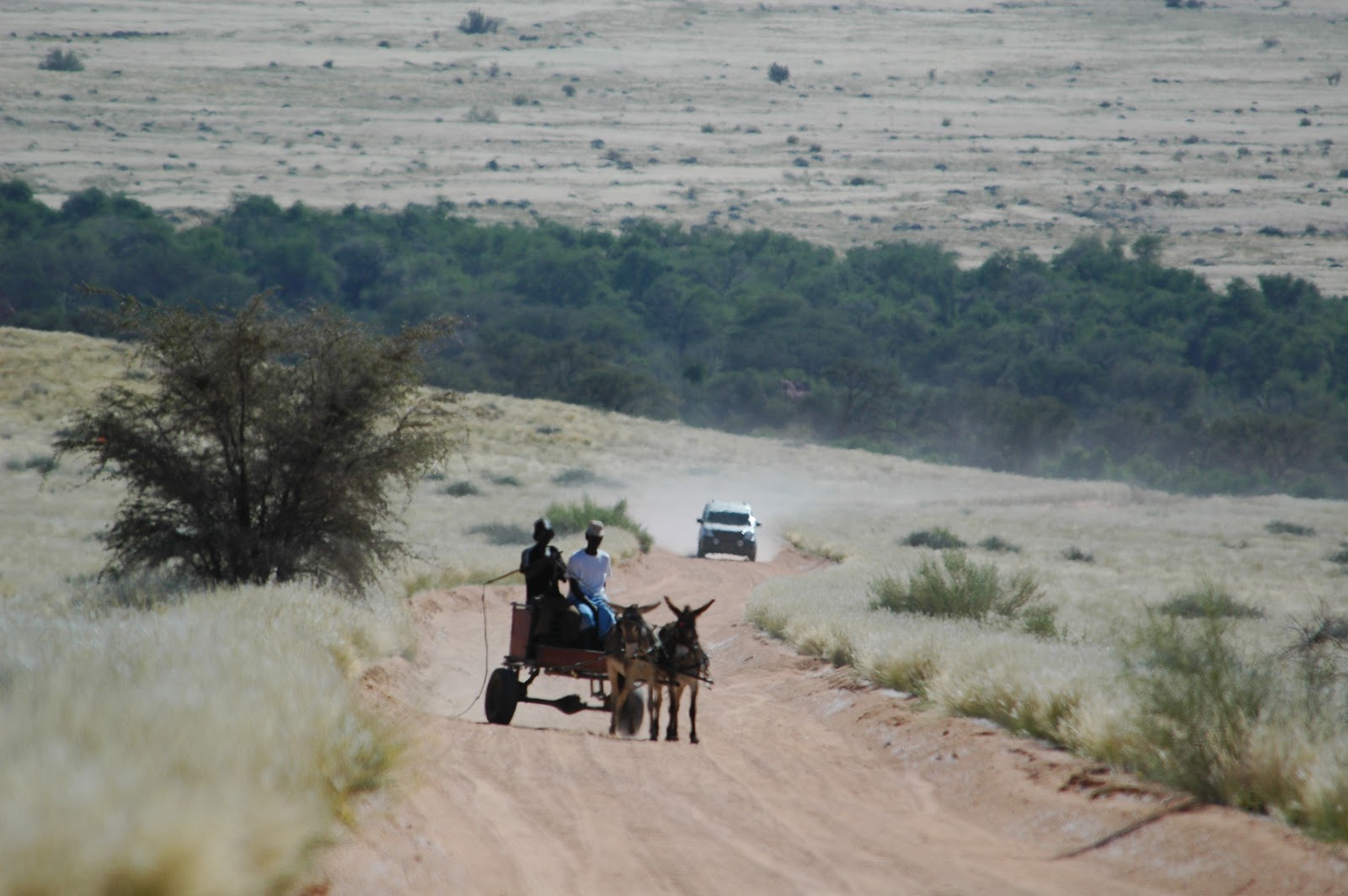
Worlds colliding: Two forms of transportation--Damara people
near the Brandberg, near Uis, Namibia.

Pemaquid Point Lighthouse, Maine.

Dancing droplets: Irrigation of corn in the Nebraska Sandhills.

Flamingo flood, Namib Desert: Heavy rains in Namibia during
January-May of 2011 created waterbodies where none had been
in recent times. These flamigos found a wide river in the
Namib Desert, near Walvis Bay.

Upland Sandpiper: near Rose, NE

Biplane aerodynamics: Morning in Nebraska Sandhills, along a road.
There were tens of dragonflies resting on plants, like this.
I took the photo from my pickup, driving slowy forward and
snapping lots of angles until I got straight in front. I like this one the best.

Eastern Kingbird: near Rose, NE.

Drafting: Snow Geese and jet near Kearney, NE.

A quiet courtyard in the old city of Barcelona, Spain.

December 16, 2011

Around the world with gorillas

A male mountain gorilla chews on vegetation while tourists
watch in Rwanda (photo by Reid and Gus Bates).
Our family met the Bates family from Louisiana while we were on our sabbatical in Namibia. They were also on a Fulbright fellowship, and our kids went to the same school in Windhoek.  We had some great adventures (here, here, and here) during 2009.

While we settled back in the States, the Bates family found another opportunity to travel in Africa...with another adventure to Rwanda. They recently had the opportunity to mingle with mountain gorillas! You can read about their exciting day by going to their blog here. In short: they paid to spend the day sitting in the forest just feet away from a group of gorillas!

The Bates' experience is just one more example of innovative ways to support conservation. As we look to the future in the Great Plains and the world...innovative solutions are going to come in many forms.  And, they will not be easy.

On their blog, Gwen sums it up well:

The gorillas are truly one of the few great natural resources that Rwanda possesses. They bring in millions of dollars to the economy in terms of tourists buying permits, paying for accommodations, spending money on food and souvenirs, drivers and petrol. They unfortunately are under great pressure from loss of habitat, poaching, and disease. It’s quite a balancing act that has to take place to keep all the elements in equal proportion and not letting one element tip the scales. How long Rwanda can continue to do so is anybody's guess.

Clean-up on aisle 12...!

(Photo by Mark Havnes | The Salt Lake Tribune) An Eared Grebe waits in a box on
Wednesday to be released after crash-landing in Cedar City on Monday night
apparently thinking some areas were water. At least 1,000 birds died
and 2,000 survived to be transferred to reservoirs in Washington County
(text from the Salt Lake Tribune).
Making news this week: the crash-landing of thousands of grebes in a Walmart parking lot in Cedar City, Utah.  The death toll looks to be about 1,500 birds according to press accounts.

Evidently, the birds were migrating in a storm and mistook the parking lot for a lake surface.  There have been myths about ducks mistaking the blue football field at Boise State (Idaho) for a lake, but they appear to be untrue.

Ecological traps are situations in which animals respond to cues, which normally would lead to enhanced survival or reproduction.  But, in an altered landscape, those cues can be misleading---leading to the 'trap' of misinterpreting the cue.

A typical example of an ecological trap--birds respond to the density of non-native, cool-season grasses in the spring to build a nest.  Throughout recent history, native cool-season grasses were mixed with warm-season grasses and forbs, which provided cover and sources of insects (for food for chicks) later in the season.  Early growth of grass would normally indicate an area that would be good for nesting and rearing young.  But, where non-native brome grass has overtaken a pasture, for example (wonderful forage grass for cattle), the forbs and warm-season grasses will not 'show up' later in the nesting season.  The birds, of course, do not know this, and the situation may result in reduced productivity...hence, a trap.

As my research lab continues to work with habitat selection of grassland birds, we may find more examples of ecological traps.  But, none will probably seem as harsh as the reality of crash-landing on pavement.